Which tools can optimize your management control ?
Management control can no longer rely solely on Excel spreadsheets or static reporting. To effectively steer company performance, organizations need tools capable of structuring information, automating workflows, and ensuring reliable indicators. This is where solutions such as a DMS (Document Management System) can play a key role. Before exploring these tools in detail, let’s revisit what management control really is, its objectives, and the concrete ways to strengthen it.
In this article :

Management control: definition, role, and associated tools
Management control helps companies improve efficiency, both operationally and financially. In practical terms, it relies on various tools to compare defined objectives with actual results and, if necessary, adjust strategy or actions to stay on track.
To achieve this, management control uses tools such as budgets, dashboards, and cost analysis. However, their effectiveness depends directly on the quality and reliability of the available data. This is where a DMS makes a real difference: by centralizing contracts, invoices, reports, and financial data, it ensures fast and secure access to information while guaranteeing full traceability.
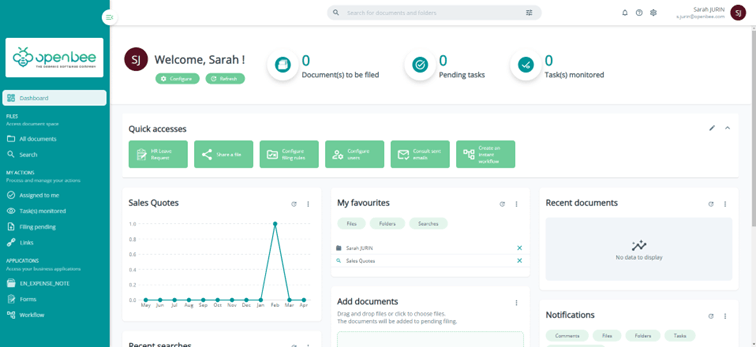
The result is greater responsiveness in management control, decisions based on reliable data, and the ability for the company to adjust its strategy much more quickly.
Management control tools supporting regulatory compliance
Compliance with regulations is not just a legal obligation—it is also essential to avoid financial risks and protect the company’s reputation. Labor law, taxation, GDPR, security, and environmental regulations each impose specific requirements in terms of evidence and traceability.
Management control tools combined with a DMS provide a concrete response: they centralize all documents, automate classification, secure access, and deliver complete histories in the event of an audit.
- Labor law: Employment contracts, amendments, employee registers— using a DMS, every HR document is timestamped, quickly accessible, and securely stored.
- Taxation: Supporting documents, tax filings, and exchanges with auditors are easily archived, simplifying preparation for tax audits.
- Data protection (GDPR): Access management and processing tracking are simplified through centralized storage and customized user rights.
- Health and safety at work (HSE): Accident reports, training certificates, and prevention plans are centralized and available to all stakeholders.
- Environmental regulations: Carbon footprint reports and CSR indicators are easily collected, shared, and produced to meet transparency requirements.
The main management control tools and the key role of DMS
Management control relies on various tools: budgets, accounting systems, dashboards, and reporting. However, their effectiveness depends on one essential condition : having reliable, centralized, and accessible data. This is exactly what a DMS provides.
Budgets and forecasts
Budgets and financial scenarios help anticipate resources and results. With a DMS, source documents (contracts, quotes, invoices) are automatically centralized and linked to financial tools, enabling planning based on up-to-date data.
General and analytical accounting
Invoices, supporting documents, and accounting entries are archived by the DMS, linked to transactions, and stored in compliance with regulations. For analytical accounting, the DMS allows each document to be associated with a project, cost center, or customer, making margin and cost calculations easier.
Budget control
Comparing forecasts with actual results, analyzing variances, and triggering corrective actions all require reliable, well-organized data. A DMS automates the collection of supporting documents (orders, contracts, invoices), tracks budget approvals, and facilitates revisions.
Dashboards and reporting
Dashboards consolidate key performance indicators for real-time performance management. Integrated with ERP or BI tools, the DMS directly feeds these dashboards with consolidated data. It can even offer its own monitoring interfaces (invoicing, HR, processing times), turning document management into an operational steering tool.
Consolidated reporting
Finally, for executives or shareholders, the DMS automates the creation, sharing, and secure archiving of financial reports, while preserving the full document history for rigorous long-term monitoring.
In summary, the DMS does far more than store documents. It feeds, structures, and secures all management control tools—from initial budgeting to final reporting.
Also worth reading:
7 easy tips and tricks to get started with Open Bee
How DMS strengthens document compliance
Ensuring document compliance requires securing access, guaranteeing traceability, and meeting sometimes very strict legal obligations. Here, the DMS plays a central role by embedding these requirements directly into the company’s daily processes.
- Security and access rights: Fine-grained permission management limits the risks of data leaks or errors while ensuring that only authorized users can view or modify sensitive documents.
- Traceability and auditability: Every action is logged and timestamped, providing immediate evidence during internal audits, external inspections, or disputes.
- Legal archiving: When combined with an electronic safe compliant with NF Z42-013 standards, the DMS ensures document integrity and retention for the legally required duration.
- GDPR compliance: Identification of personal data, access control, and management of deletion or rectification requests are all simplified through the DMS, supporting compliance with European regulations.
- Electronic invoicing reform: By integrating an Approved Platform, Open Bee DMS enables organizations to prepare, transmit, and archive invoices in full compliance with new tax obligations.
By embedding these capabilities at the heart of the document lifecycle, the DMS transforms compliance into a smooth, automated process—reducing risks while strengthening transparency and stakeholder trust.

